Femur fractures
Procedure
- 1.Check distal PMS.
in a position to allow sufficient distance for the injured leg to have the stirrup bandage secured to the board, providing in line traction. The patient’s head may extend beyond the upper end of the board and require support during the application of traction and transport. Cardboard splints under the patients back and head may be one option to provide patient comfort.
Secure one end to the backboard at a handhold above the patient’s hip, pass it under the femur, up through the groin, over the top and tie it snugly to the same handhold. Do the same on both femurs. This forms a sit harness that prevents the patient from sliding along the board and provides an anchor point or counter traction for the traction that will be applied.
Ensure that the stirrup bandage pulls on the distal tibia/fibula, not across the bones of the foot.
and secure the stirrup bandage to the foot end of the backboard. This is best accomplished with two patrollers to maintain traction while securing the stirrup bandage to the end of the backboard. Let patient comfort guide the amount of traction that is needed.
Pad under the knees as needed.
- 7.Recheck distal PMS.
- 8.Transport to medical aid.
Related
- 1.Tie two cravat bandages together.
- 2.Place the knot on the edge of the sole at one side of the boot.
- 3.Place the bandage under the sole and up the other side of the boot.
- 4.Have the patient hold the short end of the bandage.
the ankle) and over the bandage held by the patient.
and bringing it forward over the starting point in front of the ankle.
- 7.Insert the end under the loop in a direction from the foot toward the knee.
- 8.Fold down both ends of the bandage, away from the patient.
in line with the centre of the lower leg. That is, the loops are neither toward the front nor the back of the ankle.
- 10.Using this bandage, hold traction (as illustrated).
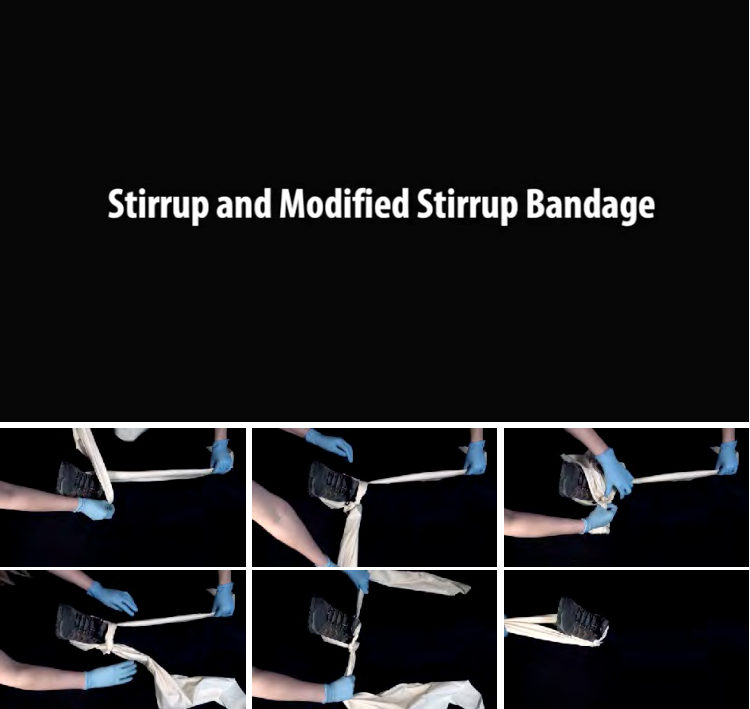
Figure 13-17: Stirrup bandage
Chapter 13, p. 214- 1.Fold two cravats in half.
- 2.Pass the folded end of one cravat under the patient's ankle(s).
The points of each should point toward the feet.
in a direction away from the feet, toward the patient's knees.
to snug the bandages to the ankle, in line with the centre line of the leg (This minimizes the chance of rotation during traction).