Lower arm
Procedure
in a deformed position with obvious angulation apply inline traction to realign the deformity towards the correct anatomical position. If the limb does not realign with attempted inline traction, then splint in the deformed position.
Place the arm in a padded splint which covers both the anterior and posterior of the lower arm and hand. The splint should extend beyond the fingertips and elbow.
to the elbow, ensuring that circulation is not impaired. This acts to hold counter traction when the patroller releases traction. Place the centre of the bandage on the outside of the splint. Pass the ends around and tie on the outside of the splint with a reef knot.
a) Start with the centre of the bandage at the bottom of the splint at the wrist and bring the ends around to the top of the splint still at the wrist. b) Cross the ends and bring them back down to the bottom. c) Cross again and bring back the bandage in front of the thumb and tie. d) Note that the fingers and thumb should be exposed to check for circulation.
- 2.The figure of eight maintains traction of the lower arm when the patroller releases traction.
- 5.Use a large arm sling to support and immobilize the lower arm.
and cross it under the distal end of the splint and tie on the uninjured side. Add padding under the knot as necessary.
- 7.Check distal pulse motor response and sensation.
Related
and positioning the lower arm at 90 degrees to the upper arm.
Slide one end of the triangular up through the hollow that has been created at the patient's elbow. Make sure the point of the triangular bandage is directed toward the elbow.
and over the shoulder on the uninjured side around the neck and over the shoulder on the injured side.
to strengthen it and work it gently toward the hand so that the front edge covers the tip of the little finger.
with the knot located in the hollow just above the collar on the injured side.
- 6.Tuck in the loose ends.
Throughout the procedure the injured arm should be supported either by the patient or an assistant.
- 8.Pad under the knots for comfort.
- 9.Recheck distal pulse, motor response and sensation.
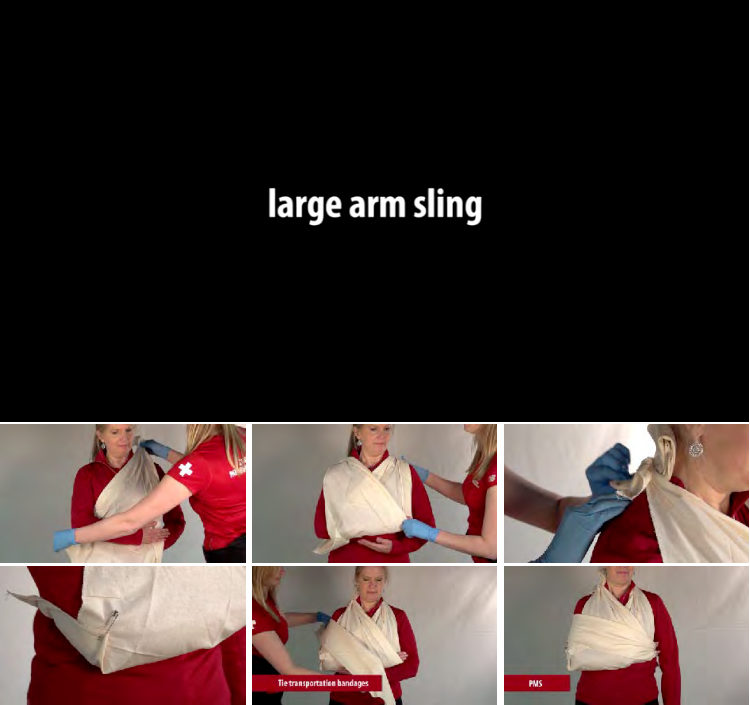
Figure 13-19: Large arm sling
Chapter 13, p. 217